
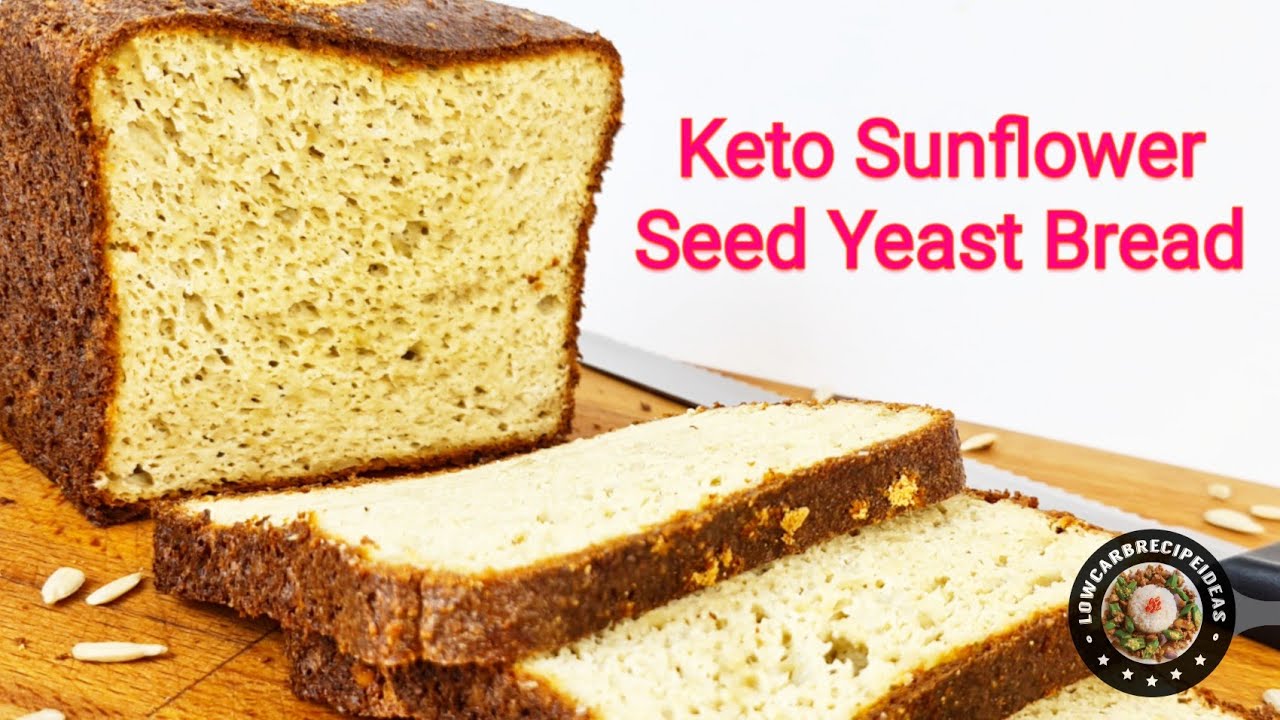
If you have been enjoying my keto sunflower seed buns or bread recipes, this yeast version will be the icing on the cake. It rises so well with an incredible texture – light, soft, fluffy and crispy when toasted. It also has a neutral taste which is great and it is excellent for sandwiches. Sunflower seeds are not only cheap but is a healthier alternative for low carb baking.
The recipe can be viewed and printed at this link;
NUTRITION INFO
[ Total Servings = 18 ]
Per Serving ;
Total Carb = 6 g
Dietary Fiber = 3.5 g
Net Carb = 2.5 g
Calories = 144
Total Fat = 11.1 g
Protein = 6.1 g
NOTE: FOR BEST RESULTS, WEIGH THE INGREDIENTS !
INGREDIENTS
DRY INGREDIENTS
Ground Raw Sunflower Seeds = 360 g / 3 cups (Refer to the video on how to grind the sunflower seeds. You can use a multi grinder, coffee bean or spice grinder or food processor)
Psyllium Husk = 27 g / 3 tbsp (Note: The psyllium husks must be ground until half its original volume before using then weigh it. This is important as it will absorb the water more effectively and this is actually more suitable for baking. However, if you are using pre ground psyllium powder, only 1 to 2 tsp is required as it is very concentrated. If you add too much, the bread will be denser, wetter and stickier. Please see this video about psyllium husk and powder for better understanding and success –
Baking Powder = 16 g / 4 tsp (If using double acting, reduce amount by half)
Salt = 1/2 to 1 tsp
Instant or rapid rise yeast = 12 g / 3 tsp
WET INGREDIENTS
Eggs = 8 large egg whites (285 g) or 4 whole large eggs (Note: The protein from egg whites will help to boost the rise substantially whereas the fat from egg yolks will hinder the rise. Using egg whites will also prevent any eggy taste. Hence, it is highly recommended to use egg whites)
Apple cider vinegar = 45 ml / 3 tbsp (You can also use white vinegar or lemon juice)
Water = 200 ml / 0.8 cup (Note: The temperature of the water must be within 122 to 132 F or 50 to 56 C. This temperature helps to wake up the yeast from its dormant state and will NOT kill the yeast)
DIRECTIONS
1. Preheat the oven to 210F or 100C and leave the heat on throughout the proofing process.
2. Mix the very warm water with the instant yeast and a pinch of sugar (optional). Stir to combine and set aside. Sugar is optional as it only feeds the yeast and does not activate it. The yeast can actually feed on any little sugar from the flour. This step is actually to wake the yeast up and if there is any little bubbling then we know the yeast is in good condition. If there is completely no bubbling then you need to change the yeast.
3. In a bowl, mix all the dry ingredients until well combined.
4. Add the wet ingredients including the yeast mixture and mix to combine. Do not overmix.
5. In the video, I used an 8 x 4.5 x 4.5 inch loaf pan which was greased with butter and lined with parchment paper at the bottom. The reason I did not line the sides of the pan with parchment paper is to allow the dough to cling to the sides to climb up. It is important to use a narrow and tall pan for yeast bread as it allows the yeast to rise upwards. If you use a pan that is too big, the dough will expand sideways to fill up the gaps hence, the bread will look big but flat. You can easily get this pan size from Amazon at an affordable price. I also bought my loaf pan online from Lazada Malaysia. It is a heavy duty and non stick pan which is excellent for yeast bread.
6. Pour the dough into the pan and sprinkle the top with coconut flour to prevent the dough from sticking to the towel.
7. You can proof the dough in the oven or at a warm area around the house.
8. To proof in the oven, place a baking dish with boiling water at the bottom and the dough covered loosely with a towel above it. Close the oven door and proof at 210F or 100C. The humidity and warmth creates a very conducive environment for the yeast to thrive and it will NOT kill the yeast.
9. The dough will double in size around 20 to 30 mins. However, there’s a tendency for the top to flatten or deflate as too much expansion inhibits further rise of the dough because the yeast cannot produce any more gasses hence, the dough will flatten or deflate. To avoid this, proof until 3/4 high which will take around 15 to 20 mins only. You need to check on the dough closely to avoid it from rising too high. Then remove the water and bake at the lowest rack at 350F or 180C for 1 hour. Even if there is any flattening at the top, it will be minimal.
10. Cool completely on a wire rack.
11. The bread can be kept for a few days at room temperature if you have a cool and dry climate. Otherwise, it’s best to refrigerate them earlier. They can be refrigerated up to 1 week and frozen for months.