Food for Thought with Kat
Eat this delicious fall dish at least two to three hours prior to going to bed for best sleep results.
PROVIDED
A nutrition columnist explains sleep’s role in metabolism and health, shares natural sleep remedies and offers a stuffed delicata squash recipe.
Daylight isn’t the only thing many of us are missing these days. Whether the clocks turn back or spring ahead, it feels a bit like we’ve taken an intercontinental trip each time daylight savings hits. We feel jet lagged. Our bodies are programmed to feel a certain way at a certain time of day. Whether it’s time to wake up, go to sleep, or just eat dinner, many of us find ourselves upside down after daylight savings.
History
So why do we need sleep anyway? The idea of sleep has always seemed strange to me. We shut off and literally recharge as if we were robots. We are out like a light, dead to the world…until we reach our ultimate recharge (or our alarm goes off) and we arise feeling rested and ready to start our day. (Or are ready to go back to sleep).
Matthew Walker, Ph.D. wrote “Why We Sleep: Unlocking the Power of Sleep and Dreams” back in 2017. In just the first few paragraphs, which happened to be about night owls, he addressed the stigma about people who stay up (and wake up) late. It’s not their fault, Walker says. Immediately, all judgment I had about my nocturnal mother drifted away. It was the way she was wired.
Walker says being a night owl is not a sign of laziness at all. It’s simply how some people are wired. In fact, Dr. Walker likens our sleep patterns to genetic traits as inherent as our eye color and argues that it cannot be changed or overcome by willpower.
While this may come as a relief for some, for many, it is merely insult to injury. Even night owls have to function and work nine to five jobs sometimes! Regardless of the implications of daylight savings, however, one thing is certain: we need sleep. Good quality sleep.
Importance of sleep
In spite of wondering why we sleep, we can all agree that sleep is important. “Sleep hygiene” has become all the rage: especially for millennial parents trying to buy their kids (and themselves) the best sleep possible. Black out curtains and even travel black out tents prevail in the baby market today. Sleep hygiene involves a dark environment (hence the black out curtain) in a quiet room (so quiet you need a white noise machine) in a room at a constant temperature. No screens (duh) and going to bed at the same time each night. Many sleep hygiene aficionados will create a bedtime ritual for themselves such as a bath time, relax time, reading time and bedtime.
Many people steer clear of heavy meals before bedtime to enhance sleep and to avoid feeling too heavy prior to bedtime. While there is nothing wrong with any of these routines or habits, it’s important to create an individual routine that works for you.
While some report that sleeping with a full stomach creates a better sleeping state, others report that eating within 2-3 hours is best for quality sleep.
Circadian rhythm
Our body naturally creates its own circadian rhythm, establishing a 24-hour clock that controls our physical, mental and behavioral processes.
I have wondered how trees on the east coast take their cue from the calendar and begin to turn almost immediately after we flip the page to September. There’s nothing like fending questions from a six-year-old to sponsor some good old-fashioned research. It turns out that once we start losing daylight on June 21 each year, trees take notice. They get less sunlight, produce less chlorophyll, and lose their leaves, essentially tucking themselves into winter.
Our circadian rhythm feels similar. Our inner clock is regulated by our brain that also takes cues from light and darkness. Instead of chlorophyll, we regulate hormones like cortisol, which promotes alertness and melatonin, which promotes sleepiness.
To many of us, sleep can be seen as idle time where we area not being productive. However, while we slumber, our body is very busy. Not only does our brain shed toxins during sleep, but in a process called memory consolidation, sleep reportedly helps us to lock in pieces of information we’ve just learned or experienced. While many students stay up to cram for a test (I’m sure we’ve all done it,) studies prove that people who slept after learning information did better on tests.
Over a third of us don’t get enough sleep, which increases our risk for obesity. A 2020 analysis determined that adults who sleep less than seven hours a night increase their chances for obesity up to 41 percent. We increase our chances for type-2 diabetes even more when we get fewer than five or six hours of sleep.
Without sleep, we’re more likely to develop high blood pressure, increased stress levels and irregular heartbeats. Lack of sleep can negatively affect our immune system, create inflammation and affect our mental health as well.
Sleepless Snacks
Studies show that subjects who were sleep deprived over the course of two days had an increased appetite – specifically for high carbohydrate, calorie-dense foods (up 45 percent from their normal desires).
When we’re tired, our bodies constantly seek alternate sources of energy. Many of us turn to caffeine, sugar or simply extra calories to get us through the day. Have you ever woken up voracious after a night of too little (or too light) sleep only to be ravenous throughout the day? This may be the workings of our hormones, leptin and ghrelin, that regulate our appetite.
When we don’t get enough sleep, our leptin levels (the hormone that signals to us that we are full) go down, creating that ever-urgent sense of being hungry. Even after we eat, it’s hard to feel satisfied with a lower presence of leptin. Contrarily, our ghrelin levels (the hormone that makes us feel hungry) rise due to fatigue creating a double-whammy effect. Not only are our appetites stimulated, but our ability to feel satisfied is decreased!
Natural Sleep Remedies
Here are some natural sleep remedies to turn to before going to OTC remedies…or worse, prescription sleep aids.
Valerian Root: Studies conducted over forty years have shown that valerian root can help us fall asleep faster, improve the quality of sleep and help to drive us into a deeper sleep stage.
Lavender: This is a well-known sleepy scent. More studies are needed to determine its full side effects and benefits.
Passionflower: In a small study, this extract was shown to increase sleep time, decreasing the time subjects spent tossing and turning.
You’re telling me to drink beer!?! Well…not exactly…but you may have noticed the calming effects beer has had in the past on you or someone you know. That’s because of the hops, the female flower used to make beer. As an extract, hops can be used as a mild sedative for anxiety or for lack of sleep. Take some before you hop into bed.
Magnesium/Calcium: As part of their natural effects, magnesium and calcium are both sleep aids. They can be used to quell any leg cramps you may experience at night as well.
L-theanine: This is an amino acid found in mushrooms and green tea. It not only helps to maintain a tranquil alertness during the day but also helps to achieve a deeper sleep at night. Make sure you find a brand that is pure L-theanine.
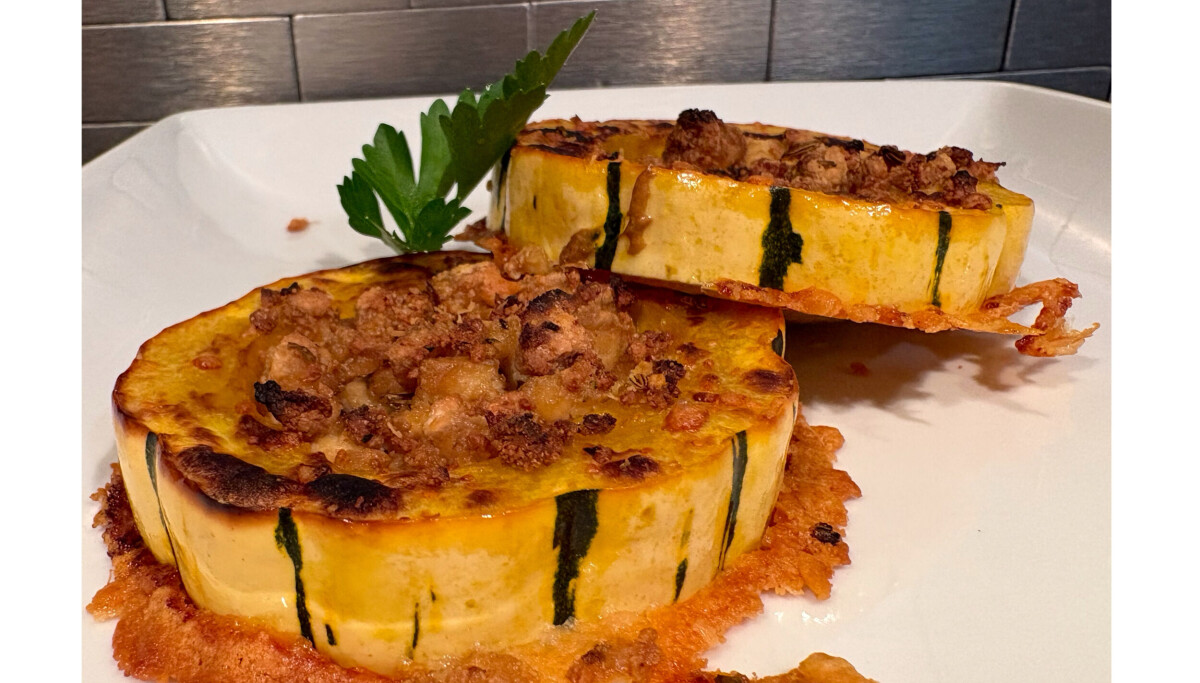
Glycine: This can be taken in supplement form to promote sleepiness, but it’s found in many foods as well. It is thought to lower our body temperature, signifying that it’s time for bed. Sources include meat and meat products like bone broth, poultry, fish, beans, spinach, kale, cabbage and fruits such as banana and kiwi. Tofu is one of the top sources of glycine. Eat this delicious fall dish at least two to three hours prior to going to bed for best sleep results.
Fall into Stuffed Delicata Squash Ingredients
1 delicata squash (skin on) – washed, deseeded, and sliced into rings
1 block extra firm tofu
1 teaspoon fennel seeds
2-3 tablespoons extra virgin olive oil (divided)
1 tablespoon soy sauce
1½ teaspoon garlic powder
1½ teaspoon onion powder
Pinch salt & pepper to taste
1 cup shredded Parmesan
Italian seasoning
Paprika
Method
Preheat oven to 400°F.
Squeeze as much water out of tofu block as possible and crumble it into rough crumbs.
Mix fennel seeds, 1 tablespoon olive oil, soy sauce, garlic powder, onion powder, salt and pepper together and toss with tofu crumbles.
On a cookie sheet, place about 2 tablespoons of Parmesan into circles – one for each squash ring.
Take squash rings and lightly coat with olive oil, placing them on the Parmesan circles.
Place tofu mixture in the center of each squash ring.
Bake for 20-25 minutes or until the tofu is golden brown and the squash is tender.
Garnish with parsley and serve hot.
Katharine A. Jameson, a certified nutrition counselor who grew up in Williamsville and Townshend, writes about food and health for Vermont News & Media. For more tricks, tips and hacks, find her on Instagram: @foodforthoughtwithkat