
Get a 14 day free trial with the MactorFactor nutrition app:
‣ http://bit.ly/jeffmacrofactor (remember to use code JEFF for the trial)
Take my Muscle IQ Test here:
‣ http://jeffnippard.com/muscleiq
I’ll be going over the correct answers in a video once I collect enough responses! Your results will be 100% anonymous. Over 50,000 people have taken it already!
Get PEScience Cake Pop Protein here:
‣ https://pescience.com/discount/Jeff?redirect=/collections/all-products/products/select-protein?variant=39523531653195
Get my Ultimate Guide To Body Recomposition here:
‣ https://shop.jeffnippard.com/product/the-ultimate-guide-to-body-recomposition/
If you’re still in your first 1-2 years of lifting, I strongly recommend running my Fundamentals Program: https://shop.jeffnippard.com/product/fundamentals-hypertrophy-program/
——————————-
Help SUPPORT the channel by:
1. Trying one of my training programs: → http://www.jeffnippard.com/programs
2. Checking out what my sponsors have to offer:
▹ MASS (Monthly Research Review)
‣ https://bit.ly/jeffMASS
‣ Only $25/month (pre-paid yearly)
▹ PEScience Supplements
‣ https://www.PEScience.com
‣ Use discount code JEFF to save $$
▹ RISE Training Gear and Sportwear
‣ http://rise.ca/jeff
‣ Use discount code JEFF to save 10%
The shirt, shorts and belt I’m wearing in this video can be found through this affiliate link. I earn a commission when you shop through the link below:
http://rise.ca/jeff
——————————-
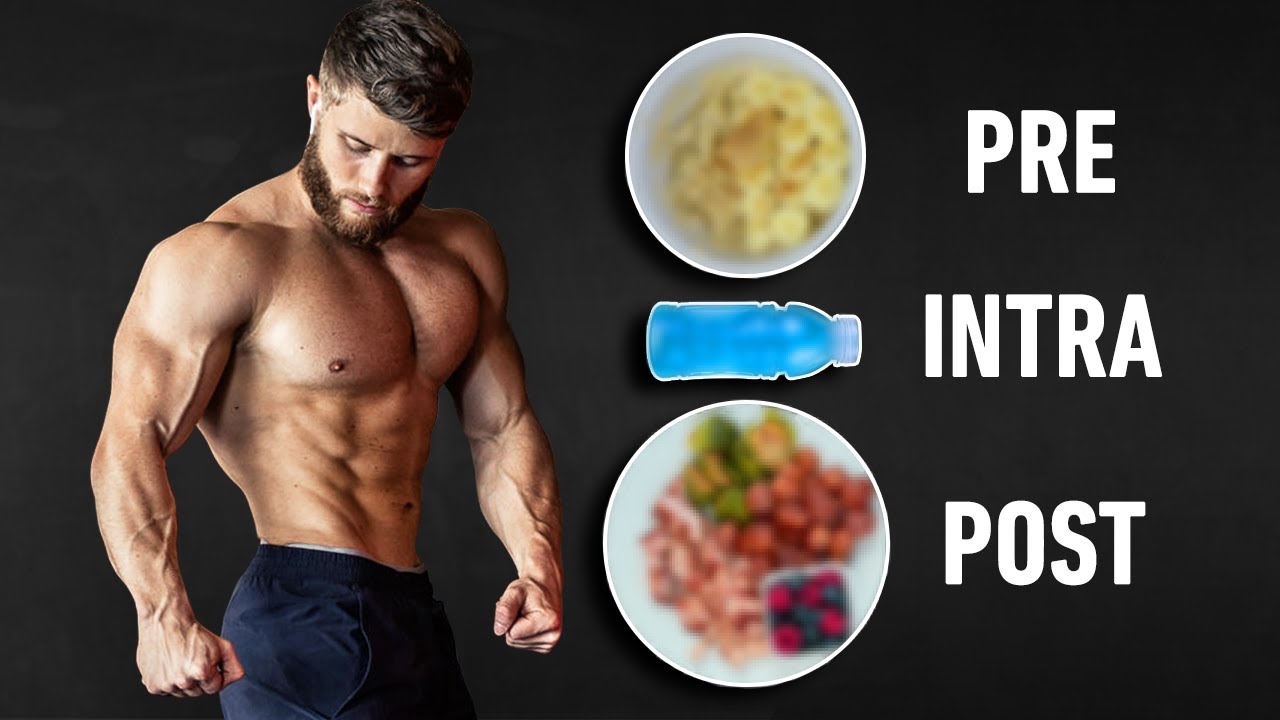
In this video I’m covering the science and practice behind pre-workout, intra-workout and post-workout nutrition. What should you eat before a workout? During a workout? After a workout? I’ll also walk through some meal examples and explain why they work well.
0:00 – Nutrient Timing Science
1:58 – Pre-Workout
6:55 – Intra-Workout
8:05 – Post-Workout
11:37 – Macrofactor Nutrition App
——————————-
References
Nutrient Timing Revisited Review:
https://www.researchgate.net/publication/235381974
Additional Resources on Nutrient Timing:
https://pubmed.ncbi.nlm.nih.gov/24299050/
https://pubmed.ncbi.nlm.nih.gov/28919842/
https://pubmed.ncbi.nlm.nih.gov/29414855/
https://pubmed.ncbi.nlm.nih.gov/26697098/
Music:
Jeff Kaale – Morning Tea
Damma Beatz – Snickers
More Scrubs
NEAR
Written by:
Jeff Nippard
Filmed by:
Aous Photo, Stephanie Buttermore, Jeff Nippard
https://aousphoto.com/
https://www.instagram.com/aousphoto/?hl=en
Edited by:
Jeff Nippard (using Final Cut Pro)
——————————-
Follow me on social media:
INSTAGRAM ‣ http://instagram.com/jeffnippard
SNAPCHAT ‣ http://snapchat.com/add/jeffnippard
FACEBOOK ‣ http://facebook.com/jeffnippard
TWITTER ‣ http://twitter.com/jeffnippard
PODCAST ‣ The Jeff Nippard Podcast on iTunes and Stitcher
——————————-
About me: I’m a Canadian natural pro bodybuilder and internationally-qualified powerlifter with a BSc in biochemistry/chemistry and a passion for science. I’ve been training for 12 years drug-free. I’m 5’5 and fluctuate between 160 lbs (lean) and 180 lbs (bulked).
——————————-
Disclaimers: Jeff Nippard is not a doctor or a medical professional. Always consult a physician before starting any exercise program. Use of this information is strictly at your own risk. Jeff Nippard will not assume any liability for direct or indirect losses or damages that may result from the use of information contained in this video including but not limited to economic loss, injury, illness or death.
what should you eat before during and after your workout to maximize muscle growth and body composition this question refers to what’s called parry workout nutrition which just means the timing of nutrients around a workout and let me start by saying that while i will be giving detailed meal examples in this video it’s important that we start with what the science actually says about this question in the first place why does periworkout nutrition matter at all well in a now infamous paper titled nutrient timing revisited aragon and schoenfeld quote challenge the classic view of post-exercise nutritional intake with respect to anabolism and many science lovers took this single paper to be the nail in the coffin for the bros now outdated anabolic window concept apparently nutrient timing didn’t matter after all well it turns out many of the science guys may have jumped to conclusions a little too quickly because even in this very paper the author suggests that pre and post exercise meals shouldn’t be separated by more than three to four hours or maybe five to six hours if you eat a large pre-workout meal let’s just meet in the middle and say four to five hours between the pre and post-workout meals is the true size of the science-based anabolic window so the periworkout window definitely matters but it matters more for some than it does for others it’s more important if you’re leaner because you have a lower nutrient supply it’s more important if you’re on lower total calories because you’re at a higher risk of muscle loss and it’s more important for those who do higher volume bodybuilding style training which depletes more nutrients than lower volume power lifting workouts now before we hop into the specifics there’s a future video that i’m trying to make that i really need your guys help with so if you go to jeffnipper.com forward slash muscle iq you’ll find a bodybuilding and fitness iq test that i made that’ll take you about five to ten minutes to do and i’m doing this because i want to see how much you guys have learned from me over the years and to test and see how smart you guys really are so there’s just straightforward multiple choice questions and i think it’d be a very cool future video to see how well you guys do and we can go over the answers together so please do me a huge favor and go to jeffnipper.com forward slash muscle iq and take five minutes to do the test okay let’s get to some meal examples all right so the pre-workout meal is the single most important meal of the day in my opinion that’s because it’ll ultimately determine how effective your training is which ultimately drives muscle growth and there are two main purposes of the pre-workout meal the first is to fuel the workout primarily via carbohydrate and the second is to provide an anabolic environment during training primarily via protein now when it comes to the macros for the pre-workout meal i am for about 1 gram of carbohydrate per kilogram of body weight ideally coming from a lower glycemic carb source plus a serving of fruit this combination of carb sources will provide more sustainable energy through the workout since different carbohydrates use different transporters meaning different rates of absorption and more sustainable performance during training i’ll also aim for about 0.5 grams of protein per kilogram of body weight and 0 to 20 grams of fat depending on how close the meal is to the workout itself because dietary fat slows digestion down meals eaten closer to the workout should contain less fat and meals eaten further from the workout should contain more fat which brings me to the next question when should we eat the pre-workout meal well up front i was a bit surprised to learn that 33 percent of you don’t eat a pre-workout meal at all because you train fasted and that’s okay and i’ll have some advice for you guys here in a minute first for the other 67 eating 1 to 1.5 hours before training is usually ideal because if you eat the pre-workout meal too close to training the food might still be digesting and that can cause you to feel lethargic or bloated on the other hand if you time your meal too far from training you’re on a higher risk of having low energy or feeling lightheaded so that’s my sweet spot but sometimes it’s just not possible to wait an hour or an hour and a half after eating because of time constraints sometimes you’re just forced to hit the gym on short notice in which case you’ll want to focus on eating a lower calorie meal with faster digesting foods and by the same token if you know you’re going to train more than one to 1.5 hours after eating you want to have a higher calorie meal and prioritize foods that digest more slowly okay so let’s start with a pre-workout meal example based on 175 pound roughly 80 kilo male who plans to train in about an hour to an hour and a half based on his body weight and the macro targets that we laid out he’ll want about 80 grams of carbs 40 grams of protein and 10 to 15 grams of fat so for this meal we’re making a good old bowl of protein oatmeal so basically cook 80 grams of oats and mix in one scoop of protein powder i use pe science select protein which is a blend of casein and whey and it mixes really well with oats now full disclosure i am sponsored by them and shout out to my girlfriend stephanie for the cake pop flavor idea top the oats with a sliced banana half a tablespoon of peanut butter and a pinch of cinnamon which may help keep blood glucose levels more stable into the workout and a sprinkle of sea salt especially if you sweat a lot during training and you can see the full calorie and macro breakdown of the meal here which of course you can tweak to fit your body weight and total daily calories oh and if you wanted to make this meal vegan you could just easily swap out the whey casein blend for a vegan protein like a pea and brown rice blend if it doesn’t give the right consistency in the oats you could just drink it separately as a shake next let’s look at a pre-workout meal for 120 pound or 55 kilo female who will be training a bit later so in roughly two hours again based on her body weight she’ll want about 27 grams of protein 55 grams of carbs and 10 to 15 grams of fat and because this meal is being eaten two hours before training it’d be smart to have a bit more fat than usual and a bit more fiber than usual to slow down digestion and ensure nutrients are still available for fuel into the workout so for this meal we’re doing four ounces of salmon a medium sized sweet potato a mixed green salad with some light goat cheese plus some apple slices with cinnamon and here you can see the full calorie and macro breakdown for this meal as a third example let’s consider someone who’s in a rush and needs to train within the next 20 to 30 minutes and hasn’t eaten for hours they should definitely eat something but if they have a big meal they might feel bloated or sluggish so in this case i’d recommend something light and quick like a whey protein shake and a banana these nutrients need to be absorbed quickly so we don’t want much fat or fiber and here you can see the full macro breakdown for this quick snack on the fly all right but what if you’re one of the 33 percent who trains fasted well let’s remember the two reasons why pre-workout nutrition matters in the first place to fuel training performance and to create an anabolic environment when it comes to fueling the workout yes generally speaking having at least some amount of carbohydrate before training will benefit performance however i know from my coaching experience that some people simply will perform better when they train on an empty stomach that’s usually because they train very early in the morning and either don’t have the appetite or feel sick and nauseous if they eat right away this isn’t a deal breaker world record holding power lifter russell orhy trained fasted for years while i think he’s recently switched away from that he was still able to reach truly elite level strength and size without a pre-workout meal however if you are planning on skipping the pre-workout meal then the intra-workout and post-workout meals suddenly become much more urgent so on that note let’s cover intra-workout nutrition or what you should consume during the workout itself now up front i’ll say that infra workout nutrition definitely isn’t required for everyone especially if you’ve already had a well-timed pre-workout meal but there are a few circumstances where it does make sense if you train fasted if you’re in a caloric deficit and already very lean if your workouts last longer than an hour or if you’re an elite level trainee trying to optimize every little detail and if any of these apply to you i definitely recommend having some kind of liquid carb source during your workout such as gatorade kool-aid or tang to fuel performance as a general rule of thumb i recommend 0.5 grams of carbohydrate per minute of training starting about 30 minutes into the workout so if your workouts last 90 minutes you’d consume 30 grams of carbs starting 30 minutes in however if you’re cutting and you’d rather not waste that many carbs on liquid sugar then even just 5 to 10 grams of carbohydrate can go a long way for stabilizing blood glucose and turning a bad workout into a good one and if you do train fasted or just want some extra anabolic insurance you can optionally add 5 to 10 grams of eaas or essential amino acids or if you don’t want to drop any extra cash on eaas just sip on about 10 grams of whey protein okay so the urgency of the post-workout anabolic window has definitely been exaggerated by some gym bros remember that there is in fact a four to five hour window bracketing the workout meaning if you ate your pre-workout meal one hour before training then train for an hour you’d theoretically still have two to three hours to play with for getting in that post-workout meal on the other hand if you ate your pre-workout meal two hours before training and then trained for two hours you should get your post-workout meal in as quickly as possible so same as with the pre-workout meal i recommend consuming 0.5 grams of protein per kilogram of body weight post-workout so if you weigh 180 pounds or 82 kilos you’d want about 40 grams of protein carbs are relatively less important in the post-workout meal because you no longer need to use them as an immediate energy source and most typical weight training sessions don’t actually deplete as much glycogen as some bodybuilders lead on anyway plus research shows that any lost glycogen should be replenished within 24 to 48 hours as long as you’re eating some carbohydrate at some point after training however because rates of glycogen resynthesis are at their highest within the first few hours following training it would be smart to include at least some carbohydrate in the post-workout meal especially if you do full body training or two-a-day workouts where you’ll be hitting the same muscle again within the next day or two assuming you have plenty of carbs to spare then one to 1.5 grams of carbs per kilogram of body weight is a good target however when cutting you may be more limited on carbs in which case something around 0.5 grams per kilogram may be more appropriate and i’d recommend including another serving of fruit in the post-workout meal as well now when it comes to fats i don’t think they’re as big of a deal in the post-workout meal simply because rate of digestion is of relatively less importance the workout has already been fueled and there’s typically no major urgency to get those nutrients absorbed as quickly as possible still if you do find yourself on the outer edge of that four to five hour anabolic window it wouldn’t be a bad idea to keep fats down below 10 to 20 grams just to ensure digestion isn’t slowed down excessively under most circumstances though this isn’t something i personally nitpick over too much okay so let’s look at three optimized post-workout meal examples up first again we have our 175 pound or 80 kilo male with a post-workout macro goal of 40 grams of protein 80 grams of carbs and 10 to 15 grams of fat this is a post-workout meal i’ll personally have very often so i’ll mix up a bowl of extra lean ground turkey jasmine rice low-fat sour cream low-fat shredded cheese and sriracha and then i’ll have a sun gold kiwi as my post-workout fruit source for obvious reasons and a mixed green salad to hit some veggies and if you need some extra protein you can add a glass of milk or just some extra ground turkey as needed to your protein target and here you can see the total calories and macros for this meal the second example is the 120 pound or 55 kilo female lifter and she could do something like four ounces of chicken breast or a protein equated amount of tofu as a vegan option with 300 grams of baby golden potatoes a few steamed brussels sprouts a small handful of salted pistachios and 100 grams of mixed blueberries and raspberries and these are the calories and macros for this meal and then finally let’s cover someone who trained fasted and has to drive back home or go to work before they can have their next meal in another hour or two in this case i would recommend having a protein shake right after training plus a serving of fruit like a banana or some grapes and depending on your total carb intake perhaps a couple rice cakes as well so this would be the total macro breakdown for this quick post-workout snack and then they would have their first whole food meal a couple hours later and before you guys click out i want to tell you about a very important announcement so over the last few months i’ve been beta testing and helping customize in my opinion the best nutrition and macro tracking app the industry has to offer i’ve been working on it with two of my good friends and sports nutrition experts greg knuckles and eric trexler the app is called macro factor and it’s finally available on apple and android the app was designed to be smarter than any other nutrition app out there most apps will set you up with some pretty unfavorable macro suggestions when you enter your goals especially if you lift weights and want to build muscle whereas macro factor gives you the most fine-tuned macros possible for your specific goal activity level diet preferences and so on based on the latest scientific research macro factor has a massive rd verified food database including a very fast barcode scanner that auto-populates the macros and calories for you and unlike every other tracking app i’ve used it also accurately reports micronutrients like vitamins and minerals as well as omega-3s omega-6s cholesterol and so on and one thing that was really important to me in helping test the app is just how customizable it is you can give the app full control to create a customized plan just for you with the coaching option where your plan will be adjusted and updated every week or if you prefer to self coach you can use the manual option to tweak the targets to your exact specifications you can also adjust your numbers to be higher or lower on training versus non-training days integrate the app data with your fitbit and dozens of other health apps and there’s even an ai describe feature that allows you to add foods using your voice which cuts down on a ton of tracking time one some gold kiwi and then i add that to the plate and there it is so you guys can get started with a free seven day trial by clicking the first link in the description box below and using the code jeff to help support my work here on the channel i really think you guys are gonna enjoy it and that’s it for this one guys don’t forget to leave me a thumbs up if you enjoyed the video subscribe if you haven’t already and i’ll see you guys all here in the next one